

Useful resources for employers
Listen to the webinar
Top tips & links
Building your resilience
Small changes to make tough days easier
When life feels busy, stressful or unpredictable, it’s easy to feel overwhelmed. But resilience isn’t about being tough, ignoring problems or pretending everything is fine.
Resilience is our ability to adapt, recover and keep moving forward when faced with challenges. Like any skill, it can be developed over time through small, everyday habits and practical coping strategies.
Whether you’re dealing with pressure at work, changes at home, financial worries, health concerns or simply the demands of everyday life, building resilience can help you manage stress, maintain perspective and feel more in control.
This topic will help you understand what resilience is, why it matters and how small, everyday habits can strengthen your ability to cope with life’s challenges.
You’ll find practical tips, useful resources, and links to external support. You can also download a factsheet and poster to share with colleagues, a 10 minute webinar and explore activities designed to help you build resilience.
Why resilience matters
Most of us face challenges and pressures in our daily lives. The statistics below show the impact that stress can have on our wellbeing and why developing resilience is an important life skill.
- 964,000 UK employees experienced work-related stress, depression or anxiety in 2024/25 resulting in 22.1 million working days lost.(1)
- 41% of organisations cite heavy workload as the main cause of workplace stress.(2)
- 1 in 5 adults have taken time off work due to stress-related poor mental health in the past year.(3)
Sources: (1) HSE 2025, (2) CIPD 2025, (3) Mental health UK burnout report 2025.
This short webinar will help you learn about:
- Building resilience one step at a time
- How to focus on what you can influence
- Finishing the day by noticing what went right
- Where to go for support
A poster, factsheet and activities to use in your organisation
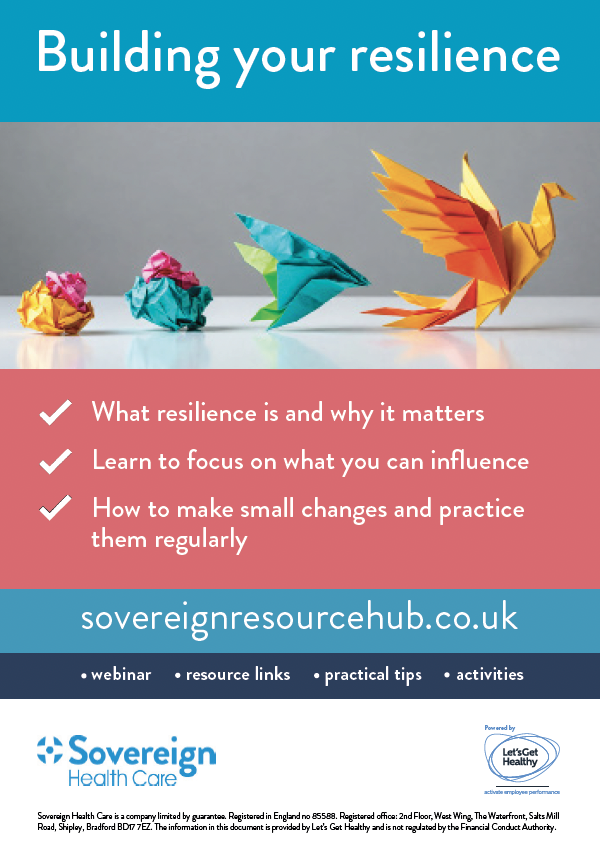
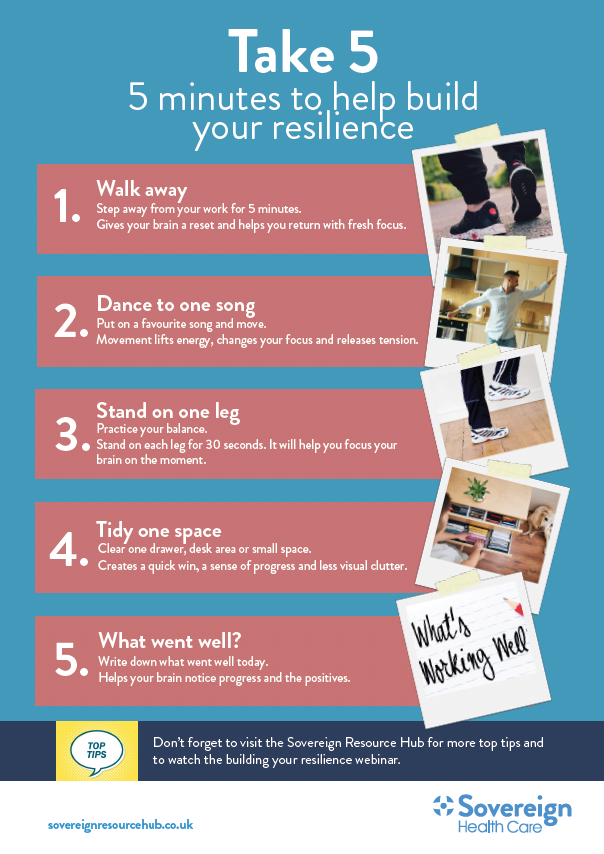
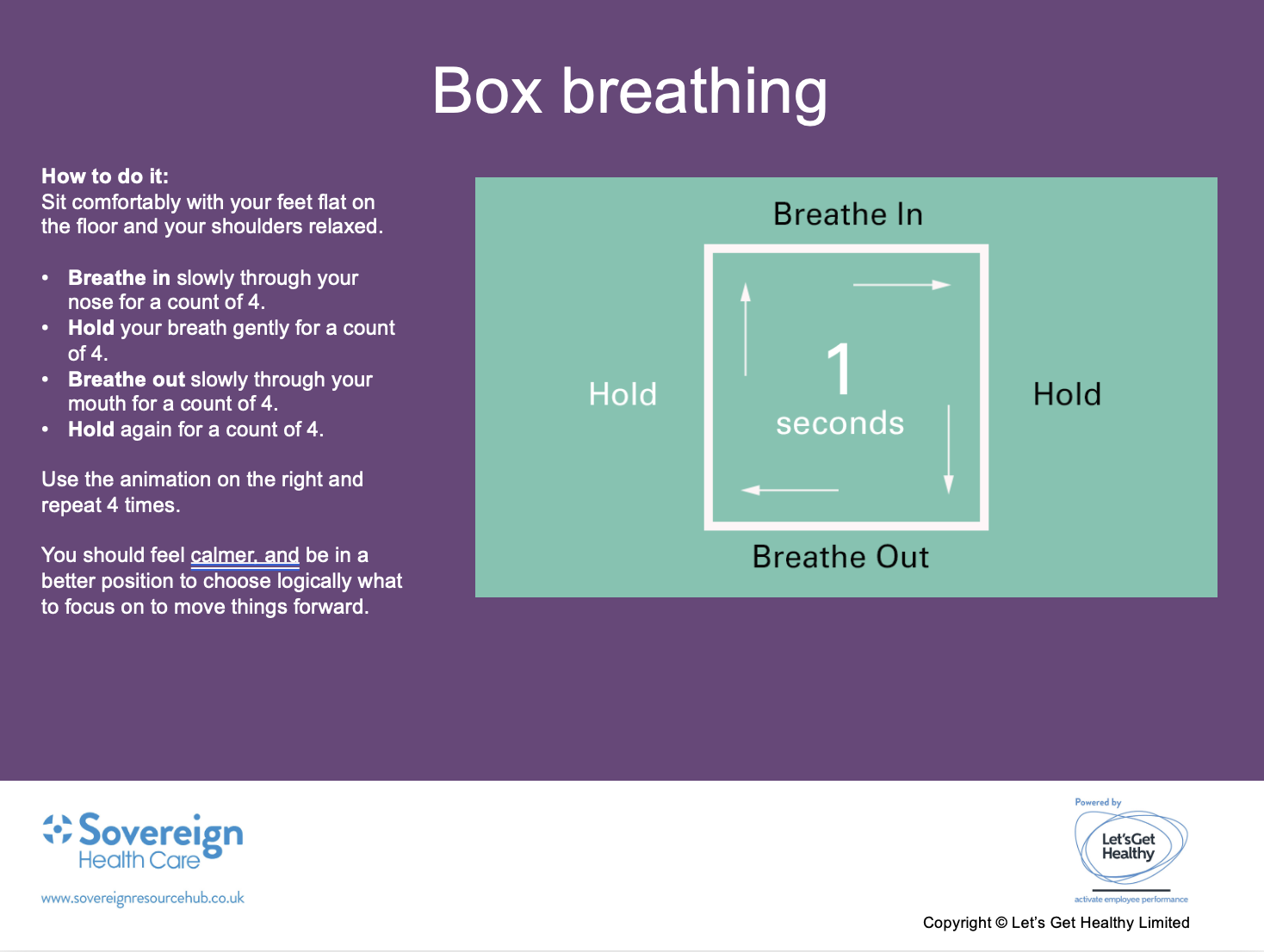
Here’s a factsheet of practical tips to help build your resilience; along with a poster. There’s also a couple of fun activities to complete too. Feel free to download and share, print and display them, or email them to your employees.
Break it down
When everything feels important, it’s easy to feel overwhelmed. Your to-do list gets longer, deadlines pile up and it can feel as though you’re constantly trying to catch up.
Instead of focusing on everything at once, break things down into smaller, more manageable tasks. Ask yourself:
- What do I need to deal with first?
- What can wait until later?
- What can I realistically achieve in the next hour?
- What might I need help with?
Then start with one thing.
Completing even a small task can help you regain a sense of control and build momentum. Rather than immediately focusing on what’s left to do, take a moment to recognise what you’ve achieved.
When life feels overwhelming, you don’t need to solve everything at once. Focus on the next small step, then the one after that.

Give your brain a reset
Have you ever spent ages staring at the same spreadsheet, email or problem and realised you’re no longer really taking anything in?
Your brain gets tired too.
If you’ve been concentrating for a long period, take a few minutes to step away. Stand up, stretch, get a drink, walk to another part of the office or, if you’re working from home, step outside for a few minutes.
The important thing is that the break is a genuine break. Switching from your laptop to scrolling through your phone doesn’t always give your brain the reset it needs.
There are lots of different ways to structure focused work. The well-known Pomodoro Technique, featured in our Beating Burnout topic, uses shorter periods of focused work followed by regular breaks. Find a rhythm that works for you.
Small breaks throughout the day can help you maintain your energy, concentration and resilience.

Focus on what you can influence
When we’re worried about something, we can spend a lot of time thinking about it without actually moving any closer to a solution.
Whether that’s something a customer said, a meeting next week, a colleague’s reaction or something that might happen, try dividing your worries into two groups:
Things I can influence.
Things I cannot influence.
Then put your energy into the first group.
If there’s something you can do, decide what the next small action is. If there’s nothing you can do about it today, give yourself permission to park it.
When you’re under pressure, watch out for words such as ‘always’, ‘never, ‘everything’ and ‘nothing’. These can make problems feel bigger than they really are.
For example you can change: “Everything always goes wrong.” to “Today is difficult, but I can work through it one step at a time.” or “I made a mistake – I’ll never fix it!.” to “I made a mistake, but I can correct it and learn from it.”
Resilience isn’t about pretending everything is positive. It’s about focusing on what you can control and taking the next step forward.

Don’t carry one bad moment into the next
A difficult call, an unhappy customer, an awkward conversation or a mistake can easily follow us around for the rest of the day. We replay what happened. We think about what we should have said. We revisit the situation again and again.
Before we know it, a 10-minute problem has taken up 2 hours of our day.
When something doesn’t go as planned, try creating your own reset. Take a couple of minutes and ask yourself:
- What happened?
- Is there anything I can do about it?
- What can I learn from it?
If there’s an action to take, take it. If there’s a lesson to learn, learn it. Then try not to give the situation any more of your day than it deserves.
One difficult moment doesn’t have to become a difficult morning, and a difficult morning doesn’t have to become a difficult day.

Finish the day by noticing what went right
Most of us are very good at remembering what we didn’t get done. We’re often less good at recognising everything we did achieve.
Before you finish work, take just 30 seconds to think of 3 things you completed, sorted out, helped with or handled well.
They don’t need to be huge achievements.
- I dealt with that difficult customer
- I finally finished that report
- I helped a colleague
- I asked for help instead of struggling on my own
- I made it through a really busy day
Once you’ve reflected on what went well, close your laptop, leave your workplace or finish your shift knowing that today is done.
Tomorrow gets its own list.

Remember to:
- Break things down into manageable steps
- Give your brain a chance to reset
- Focus on what you can influence
- Don’t let one difficult moment take over the whole day
- Take time to notice what you’ve achieved
You don’t have to completely change the way you think overnight. Resilience is built through small habits, practised consistently over time.
One small change, practiced regularly, is a very good place to start.

Additional support and resources
For more information and practical tips on building your resilience, these links are a great place to start:
NHS Every Mind Matters – NHS England’s main public mental wellbeing hub, including a section specifically on bouncing back from life’s challenges (self-help CBT techniques for resilience):
How to manage stress and build resilience | Stress | Mind
Resilience – Find ways to bounce back | Action for Happiness
https://actionforhappiness.org/10-keys/resilience
Supporting employee resilience: guide for people managers – practical guidance for line managers on spotting and supporting resilience in their teams:
https://www.cipd.org/en/knowledge/guides/supporting-employee-resilience-line-manager-guide